



Portfolio
Improve yield and prevent off-spec products with inline quality control
Pressure on sales, margins and product quality, combined with a shortage of skilled labor, drive food processors to look at more efficient ways to increase productivity uptime and reduce product losses. By supplementing or replacing laboratory measurement with inline measurement instrumentation, production check steps can be greatly improved, thus increasing throughput and reducing hold times as well as the risk of off-spec product.
All food manufacturers worldwide are aiming for less than 1% waste. But it is often far higher, 5% and more are not uncommon. Waste occurs in food manufacturing for a variety of reasons: Production changeovers, recipe failures or production delays that lead to raw material degradation and variability. The introduction of inline quality measurements helps to improve or even eliminate some of these circumstances, ensuring quality and further reducing waste.
What impact can proven inline quality control can have on your production?
By working with closely with our customers, our industry experts help implement inline quality control that ensure product quality and cuts avoidable losses. From day one, we act as reliable partner for process improvements across your entire production.
Key facts
15-30%
reduced quality related downtime.
Fewer batch failures and fewer "stop-and-check" interruptions thanks to real-time inline observation of critical process parameters.
Key facts
up to 60%
reduced product loss.
The biggest avoidable losses come from delayed detection of off-spec conditions. Continuous inline process data can close this gap compared to sampling intervals.
Where to implement inline quality control in your production
Process insights
Inline quality control depends on monitoring critical parameters directly in the running process to detect deviations early and maintain consistent product quality. These process maps give a clear overview of where such measurements can be implemented and which parameters such as flow, density, concentration, turbidity or temperature are typically relevant at each step. Short animations illustrate how inline measurement works in practice and where control points can be added without disrupting existing operations.
Measure the product concentration inline and manage your process in real-time.
Measure and manage the color of your products inline
Inline pH Measurement in hygienic applications without glass
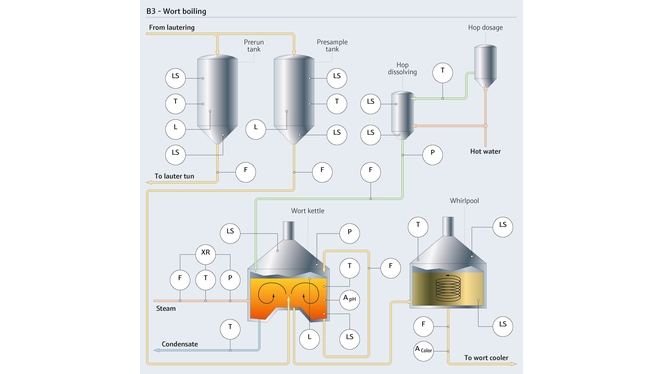
Wort boiling process in a brewery. Inline quality control of the parameter color and pH, take a closer look.
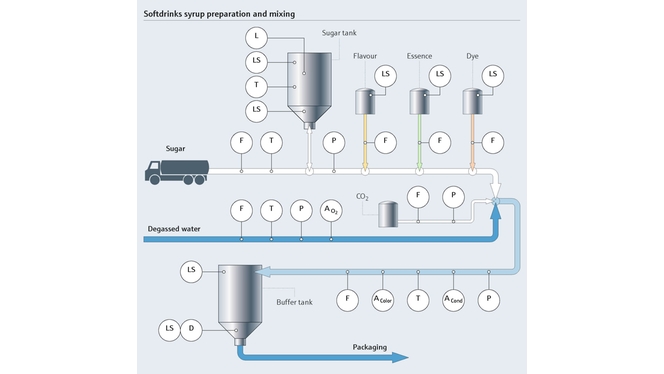
Preparation and mixing of softdrinks. Density, conductivity and color are important parameters for quality - they all can be controlled with inline measurement.
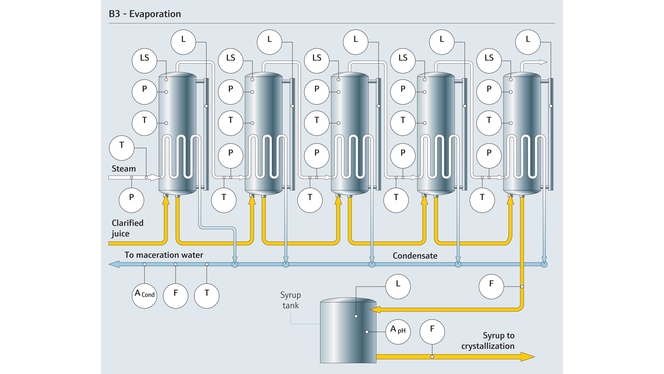
Benefit from our digital pH sensor Ceragel CPS71D in your sugar evaporation process.
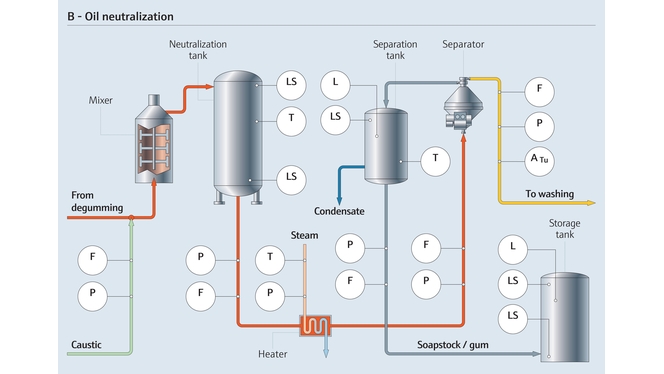
Discover our inline turbidity measurement in the process of edible oil neutralization.
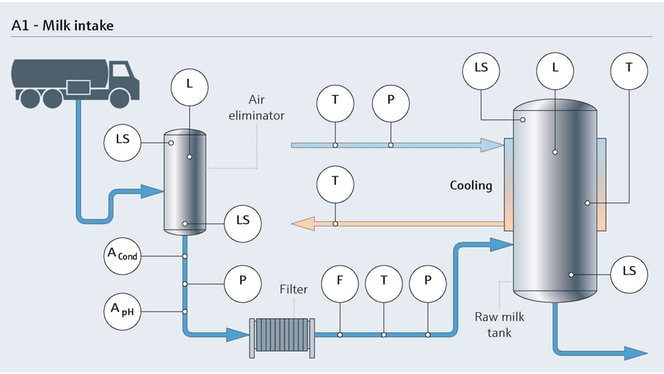
Benefit from an accurate inline flow measurement with Proline Promass Q300 in the milk intake process.


Measure the product concentration inline and manage your process in real-time.
Measure and manage the color of your products inline
Inline pH Measurement in hygienic applications without glass

Wort boiling process in a brewery. Inline quality control of the parameter color and pH, take a closer look.

Preparation and mixing of softdrinks. Density, conductivity and color are important parameters for quality - they all can be controlled with inline measurement.

Benefit from our digital pH sensor Ceragel CPS71D in your sugar evaporation process.

Discover our inline turbidity measurement in the process of edible oil neutralization.

Benefit from an accurate inline flow measurement with Proline Promass Q300 in the milk intake process.


Insights
How to ensure food safety compliance with inline pH measurement
More than 30% of all quality-relevant process measurements are related to pH. While this parameter is often used to monitor taste and consistency, the primary application is to ensure the correct pH levels in acidified foods for safety purposes.
Other examples include: monitoring the fermentation rate or determining when fermentation is complete, detecting trace CIP fluid contamination before packaging or bottling, monitoring the pH value to ensure the shelf life of the end product. Endress+Hauser offers a wide range of pH sensors, from glass electrodes and enamel sensor up to non-glass ISFET sensors.
- Rely on glass sensors like the Memosens CPS61E for precise measurements and rapidly changing pH values.
- For very sticky or viscous media such as mayonnaise, the Ceramax CPS341D enamel sensor meets the highest demands for measurement accuracy while providing optimal long-term stability and the lowest maintenance requirements.
- The Memosens CPS77E non-glass ISFET sensor can be used with peace of mind for final pH checks or in production.

Insights
Real-time concentration and density measurement
To monitor and control the consistent quality of a product, density must be measured accurately. To determine the concentration, the density values are converted to different units such as °Brix, °Baume, API, °Plato or alcohol.
The medium density can be continually (inline) monitored and controlled in a wide range of applications, drastically reducing the effort involved in regular sampling and lab analyses. Endress+Hauser offers different physical measuring principles.
- Measure density/concentration with superior accuracy using the Proline Promass Q 300. This flowmeter is optimized for liquid applications where entrained gas is known to be present.
- Continuous measurement of density, reference density and concentration of liquids with the QML51 density calculator. Maximum accuracy is achieved by using up to two Liquiphant density sensors, such as the Liquiphant FTL63, in combination with special temperature and pressure sensors like iTHERM CompactLine TM311 or Cerabar PMP43 for compensation.

Insights
Ensure consistency with continuous color and turbidity monitoring
Color and turbidity measurement are essential for quality and taste in edible oil, beverages, beer, wine and molasses. They are use in a wide variety of applications such as effluent monitoring, removing turbid substances in raw oil, product loss detection in dairies or simple phase separation.
Ensuring each of these applications and processes requires permanent monitoring of the critical parameters color and turbidity. Endress+Hauser offers a wide range of optical sensors dedicated to the specific application need.
- Precise inline color measurement in liquids in the visible region of the electromagnetic spectrum using our OUSAF22 color sensor, which measures the slightest color changes to ensure superior end product quality.
- The OUSTF10 inline turbidity sensor is used for measuring suspended solids, emulsions and immiscible fluids in process liquids.
- The OUSAF11 hygienic absorption sensor is used for phase separation or for ensuring that the right grade of milk is present.

Insights
Prevent contamination with reliable conductivity measurement
Conductivity measurement can provide early detection of contamination from improperly flushed lines or leaking valves. This facilitates early identification of the source of the issue and prevents contaminated products.
Endress+Hauser provides reliable and accurate instruments for all measurement ranges and conditions, such as CIP cycles or hygienic processes. Benefit from a wide range of sensors and transmitters.
- Where speed of response or highest accuracy is needed, the Indumax CLS54D digital conductivity sensor is unmatched in the market.
- Choose the compact conductivity device Smartec CLD18 for applications where the toroidal measurement is needed and an embedded transmitter is of advantage.
- Use the Memosens CLS82E digital 4-electrode conductivity sensor for hygienic applications that need to cover a broad measuring range such as phase separation or fermentation.

Insights
Raman spectroscopy for reliable PAT and in-process quality assurance
Inline Raman spectroscopy measurements provide in-depth chemical composition knowledge about your process without the need to collect a sample for laboratory analysis. Raman spectroscopy can monitor multiple aspects of product quality with a single probe, around the clock, thus enabling in-process corrections and faster product release.
Incorporation of Process Analytical Technology (PAT) tools, such as Raman spectroscopy, into the process during early stages of process development helps deliver consistent product and process quality. With our proven reliability, repeatability, and compliance support, we have over 30 years of customer success in process improvements after implementing Kaiser Raman technology.
- Would you like to learn more about Raman spectroscopy in the food & beverage industry? Then take a look in our application guide "Raman spectroscopy food & beverage".
Takeaway
Our offering
Inline quality measurement enables processes to run with a higher level of control. Changes in the process, caused by raw materials, energy supply or operational influences, can be detected immediately. Inline quality control tracks the process every second to complement lab testing, completing the picture and facilitating continuous quality improvements. Endress+Hauser offers a wide portfolio of technologies and process instrumentation that help you:
- Ensure product quality and protect your brand
- Avoid product losses
- Increase plant availability
- Reduce raw material
Endnotes
Related articles

